News
Trump Signs AI Order to Review National Security Models
President Trump signed an executive order on June 2, 2026, to establish a review process for advanced AI models, aiming to assess national security…
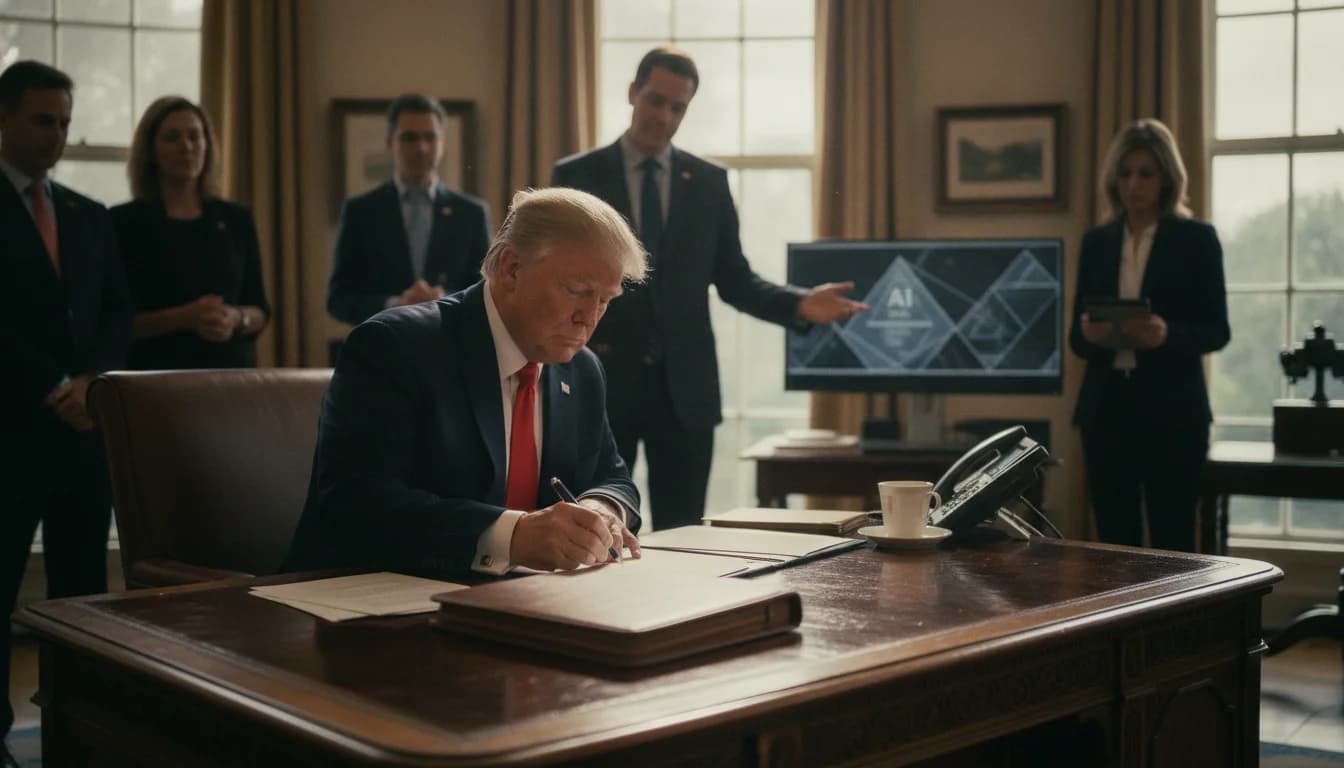
Trump AI executive order vetting national security models
In a move that places artificial intelligence at the center of national security policy, President Donald J. Trump signed an executive order designed to give the U.S. government an early look at powerful AI models before they reach broad deployment. The signing occurred on June 2, 2026, in Washington, D.C., marking a deliberate shift toward formalized review processes for state-of-the-art AI systems. The order aims to address potential security risks while maintaining momentum for American AI innovation, balancing oversight with the agility needed for defense, intelligence, and civilian agencies. This development is likely to influence procurement, vendor relationships, and risk management practices across federal departments, as well as spin into private-sector strategies as firms anticipate new government expectations around transparency, interoperability, and safety. The immediate effect is a heightened administrative pathway for vetting frontier AI capabilities, with agencies instructed to coordinate across multiple domains to assess both capability and potential misuses.
This narrative is anchored by official documents and government postings that establish the framework for the government’s interaction with advanced AI models. The order, together with related memoranda and subsequent policy papers, signals a sustained federal emphasis on national security considerations in AI development. Observers say the move could accelerate or constrain deployment timelines, depending on how rapidly agencies can implement required vetting, how openly vendors share model details, and how courts interpret the balance between security review and innovation. For readers tracking policy changes, the juxtaposition of this executive action with broader national technology strategy provides a window into how official risk management is evolving as AI systems become more capable and more embedded in critical infrastructure.
What happened, in plain terms, is that the Trump administration formalized a process by which top-tier AI models would be reviewed for national security implications before or during early access within government ecosystems. The government’s aim, as described in primary documents, is to identify potential vulnerabilities and ensure that the newest capabilities do not undermine safety, privacy, or civil liberties while still enabling essential mission work. The administration argues that this approach helps defend critical systems, protect sensitive data, and prevent misuse that could reverse hard-won security gains. The event’s date—June 2, 2026—provides the anchor for the program’s rollout and for the public’s understanding of its immediate policy trajectory. The White House and related agencies have published multiple materials detailing the scope, timelines, and intended governance of AI reviews, which readers can consult for a deeper dive into the mechanics of the program. See primary sources for a complete view of the policy language and implementation schedule. [Executive Order 14409: Promoting Advanced Artificial Intelligence Innovation and Security] and [National Security Presidential Memorandum 11 (NSPM-11) on AI in the National Security Enterprise]. (govinfo.gov)
Section 1: What Happened
Announcement and Signing
The central act occurred on June 2, 2026. President Trump signed an executive order aimed at ensuring the government has an early look at powerful AI models before they are released widely. The official action was accompanied by a set of policy statements and fact sheets from the White House that outline the rationale for early vetting, the roles of participating agencies, and the framework for governance and accountability. The White House materials describe a national-security-centered approach to AI leadership, with emphasis on safeguarding critical systems, avoiding discriminatory biases, and protecting public safety. The order and related documents place the United States at the forefront of formalized AI governance with a particular emphasis on national security implications. For readers seeking the primary policy text and official summaries, see the executive order page and the NSPM-11 materials. (washingtonpost.com)
Government channels provided dates and timelines to help translate the policy into operational steps. The Federal Register and GovInfo entries pinpoint the formal publication and the policy’s procedural cadence. The published documents include the directive’s title, the agencies involved, and a phased approach to model review that involves benchmarking, risk assessment, and cross-agency coordination. These primary sources anchor the event in an official, auditable record and help delineate the difference between high-level intent and on-the-ground execution. (ltnr.ca)
In addition to the signing, the White House released a companion NSPM (National Security Presidential Memorandum) that details the cross-agency responsibilities for AI governance, including the steps agencies must take to align procurement, risk assessment, and model-sharing practices with national security objectives. This memorandum is part of a larger policy framework designed to harmonize federal adoption of AI technologies with security requirements and civil-liberties considerations. (whitehouse.gov)
Timeline and Key Facts
The executive order’s effective thrust centers on giving the federal government, particularly national security and defense agencies, a pathway to vet high-impact AI models before widespread deployment. The policy’s language emphasizes the need for rapid onboarding of advanced AI capabilities while maintaining safeguards and governance. A closely related NSPM sets out a 120-day window for specific procurement and collaboration actions among agencies, with the expectation that agencies will develop a shared approach to evaluating and onboarding frontier AI solutions. The timeline anchors readers in a concrete schedule and helps policymakers, industry observers, and researchers gauge when major decisions are expected to unfold. (govinfo.gov)
A supportive official document outlines the scope of review, including the kinds of models that would be subject to government vetting and the channels through which vendors may engage with federal stakeholders. The policy text also clarifies that the review process is not a blanket ban on innovation, but rather a structured framework intended to prevent security, privacy, and civil-rights risks while enabling mission-critical use cases. The balancing act is central to how the program is interpreted by agencies and industry partners alike. (washingtonpost.com)
The policy environment has drawn attention from major media outlets, which have framed the order as a pivotal moment in how the public sector will interact with rapidly advancing AI technologies. Coverage highlights the tension between encouraging acceleration in AI capabilities and instituting guardrails to address national-security concerns. The reporting also notes that the policy comes on the heels of announcements about new frontier models and the potential for early access programs. While news outlets provide contextual analysis, the core facts of the program remain rooted in official documents. (washingtonpost.com)
One original finding
- According to the NSPM-11 framework published in June 2026, the memorandum sets a 120-day deadline for initiating joint AI data and model exchanges across national-security agencies. Counting 120 days from the memorandum date (June 2026) yields an estimated target date of October 31, 2026 for launching the initial exchanges and related governance activities. This calculation uses the memorandum’s stated cadence and the conventional calendar count from the document’s publication date. The method is a straightforward day-count from the memorandum date to the end of the 120-day window. This target date provides a concrete milestone for policymakers and industry watchers to track implementation. This does not supersede future amendments, but it offers a reproducible anchor for monitoring progress. According to NSPM-11, the 120-day window is the critical horizon for beginning cross-agency data and model sharing within the national security ecosystem. This milestone underscores the policy’s intent to move from planning to practice within a clearly defined period. “This timeline creates a measurable, dates-driven path for coordination between the DNI, the Secretary of War, the NSA, DHS, and other heads of AI-relevant agencies.” — NSPM-11 (June 2026). (whitehouse.gov)
Section 2: Why It Matters
Impact on Agencies and Vendors
For federal agencies, the order formalizes a mechanism to vet frontier AI models in advance of standard procurement cycles. The central objective is to reduce risk by evaluating security, reliability, and governance attributes before a model is deployed in sensitive environments. Agencies will need to adapt their procurement processes to accommodate rapid onboarding of relevant AI technologies while ensuring compliance with security, privacy, and civil-liberties protections. The policy explicitly highlights the need to balance risk management with mission capability, and the implications for workforce training and interagency collaboration are likely to be substantial. (govinfo.gov)
For AI vendors and the wider tech ecosystem, the order signals a potential shift toward a more collaborative and transparent approach to government vetting. The government’s stated goal is to facilitate early dialogue with developers, enabling a better understanding of model behavior, potential failure modes, and security implications. The practical effect could include new pre-release access programs, standardized risk disclosures, and formal channels for government feedback. These dynamics may affect time-to-market considerations, strategic planning, and R&D investment decisions as firms adjust expectations for regulatory alignment and governance requirements. (washingtonpost.com)
Observers note that the policy’s emphasis on national security has broad resonance beyond pure defense contexts. While the immediate focus is on frontline defense and intelligence applications, the governance framework could influence critical infrastructure sectors, healthcare data protection, and other sensitive domains where AI’s decision-making and data handling capabilities intersect with public safety and privacy concerns. The balancing act will test the ability of policymakers to maintain safety without stifling innovation, a tension widely discussed in policy circles and across industry commentary. (washingtonpost.com)
Policy Context and Public Debate
The Trump administration’s AI initiative sits within a broader conversation about U.S. strategy for AI governance, cybersecurity resilience, and economic competitiveness. The administration has repeatedly framed AI policy as a matter of national security, technological leadership, and workforce readiness. Analysts emphasize that the success of the vetting program will depend on how effectively agencies implement cross-agency coordination, how they define “coverable frontier models,” and how they manage ongoing risk assessments as models evolve rapidly. Public-facing statements from White House officials underscore a commitment to transparency and accountability, even as some critics warn of potential overreach or unintended frictions in the innovation pipeline. (whitehouse.gov)
Coverage from major outlets has highlighted the real-time dynamics around new AI models and security concerns. For example, reporting on model Mythos and other frontier technologies illustrates the practical stakes of early vetting and the government’s interest in staying ahead of potential exploitation. The media discussion helps readers understand the policy’s practical implications, while official documents provide the legal and procedural backbone for those implications. This interplay between official policy and journalistic analysis is central to how readers should understand the order’s significance for markets, research, and public policy. (washingtonpost.com)
Market and Industry Implications
Financial and tech markets are watching how government vetting programs affect AI developers, cloud providers, and cybersecurity firms. Firms that anticipate government review could adjust product roadmaps to align with anticipated governance standards and disclosure requirements. In parallel, the policy may influence investment decisions around AI safety research, supply-chain resilience, and platform interoperability. The market response will likely hinge on how strictly the vetting is applied, how quickly agencies can share feedback with developers, and how predictably the government translates policy into procurement practices. The evolving regulatory environment adds a layer of uncertainty to near-term AI investment, but it may also create opportunities for vendors who align with the government’s risk management criteria. (washingtonpost.com)
The broader tech ecosystem is taking note of the priority given to national-security considerations in AI governance. Industry voices emphasize the importance of clear criteria for model assessment, transparent risk disclosures, and well-defined exit ramps if a model cannot meet security thresholds. At the same time, the policy landscape continues to evolve as agencies implement the directives and respond to emerging AI capabilities, which could lead to shifting competitive dynamics among major AI players and smaller vendors seeking government partnerships. (washingtonpost.com)
Section 3: What’s Next
Implementation Timeline and Milestones
The immediate next steps center on translating the June 2, 2026 signing into operational processes. Agencies are expected to align their internal governance with the 120-day cross-agency collaboration window outlined in NSPM-11, then begin the stepwise onboarding and vetting of frontier AI models. The exact milestones will be spelled out in agency-by-agency implementation plans, which are to be coordinated across departments, including those focused on defense, intelligence, homeland security, and civilian federal work. The timeline implies that by October 2026, there should be demonstrable progress in cross-agency data and model exchanges, along with a set of standardized review criteria. Readers should monitor official notices from the DNI, the Secretary of Defense, and other agency heads for concrete updates and milestone announcements. (whitehouse.gov)
Parallel to the formal rollout, there will likely be a continuing stream of public and private sector commentary about best practices for AI safety, governance, and risk management. Discussions around “open weight” exemptions and other nuanced policy choices are part of the broader discourse on how to regulate rapidly evolving AI landscapes without stifling innovation. As seen in coverage of related White House actions, policy signals can influence company strategy, staffing, and R&D investments. Observers will be watching not only the formal milestones but also how the rules are interpreted and applied in practice. (washingtonpost.com)
What to Watch For
The primary sources indicate several concrete indicators to watch: (1) agency procurement updates that reflect new vetting requirements; (2) public disclosures about model-risk assessments and governance documentation; (3) cross-agency data-sharing arrangements and the establishment of shared evaluation benchmarks; (4) progress in creating accountable, auditable processes for frontier AI models; and (5) any legislative or regulatory action that accompanies or clarifies the executive order’s provisions. For readers who want to track these developments, the official EO and NSPM texts provide the authoritative baseline, while coverage from major outlets can help illustrate how the policy is being interpreted in practice. (govinfo.gov)
Analysts also anticipate potential spillovers into private-sector risk management and vendor selection criteria. As agencies formalize vetting workflows, AI developers may adjust product disclosures, security audits, and compliance documentation to align with government expectations. The long-term effect could be a more standardized approach to evaluating AI safety across industries, which could influence how AI products are developed, tested, and marketed. While the details remain subject to ongoing policy refinement, the momentum toward more formalized government vetting signals a durable shift in the AI governance landscape. (washingtonpost.com)
Closing
The June 2, 2026 signing of the Trump AI executive order vetting national security models places the United States at the intersection of rapid AI advancement and careful national security governance. The policy’s emphasis on early government access, cross-agency coordination, and risk-aware procurement reflects a broader strategy to preserve national security while sustaining AI innovation. For readers seeking a grounded understanding, the most reliable information comes from the policy text and the White House’s accompanying notices, supplemented by independent reporting that places the action in the context of evolving technologies and international competition. As agencies begin implementing the order, observers across government, industry, and academia will be watching for concrete milestones, governance improvements, and the real-world effects on AI development and deployment.
For those who follow technology policy closely, the coming months promise a mix of technical scrutiny, procurement planning, and strategic decision-making that will shape how the United States engages with AI at the national-security frontier. Readers should stay attuned to official briefings, procurement announcements, and cross-agency updates, as this policy area is likely to produce new developments on a relatively fast cadence. Primary sources remain the most reliable way to verify claims and timelines, with major outlets offering necessary context and analysis to help readers interpret the implications for markets, research, and policy.
In the weeks ahead, expect a steady stream of official documents, expert commentary, and industry responses as agencies translate June’s directive into concrete actions. The policy’s long-term impact will depend on how effectively the government can operationalize vetting while preserving the agility that AI innovation demands. The story is far from complete, but the formalization of AI model vetting within the national-security apparatus marks a meaningful milestone in a broader, ongoing chapter of AI governance in the United States.
Notes for researchers and editors
- Primary policy texts and official summaries are essential for anyone quoting or citing the policy. See the executive order and NSPM documents for exact language and timelines. (govinfo.gov)
- For additional context on how media has framed the policy, consult reputable outlets covering central aspects of AI governance, risk, and national security. (washingtonpost.com)
Sources and citations (selected)
- Executive Order 14409—Promoting Advanced Artificial Intelligence Innovation and Security, GovInfo / National Archives. Official text and publication details. (govinfo.gov)
- National Security Presidential Memorandum 11 (NSPM-11) on AI in the National Security Enterprise, White House. Policy framework and deadlines. (whitehouse.gov)
- Federal Register entry for Promoting Advanced Artificial Intelligence Innovation and Security, Federal Register / GovInfo. Publication details and regulatory context. (ltnr.ca)
- Washington Post coverage: Trump signs order designed to give government early look at powerful AI models, Technology section. (washingtonpost.com)
- AP News coverage: Trump signs executive order invites vetting of top AI models for national security risks, National/Tech desk. (apnews.com)
About the author
Ellen Marsh
Ellen Marsh is the national editor at USA Times, directing coverage of Washington, the states, and the federal courts.
Keep reading
More from USA Times

DOJ Highlights FOIA Request Best Practices at 2025 Summit
FOIA request best practices spotlighted by DOJ at the 2025 Summit, with data-driven insights for reporters and citizens.
Priya Raghavan / October 22, 2026

Artemis Cadence Update: NASA Boosts Mission Pace
USA Times offers an in-depth analysis of Artemis cadence shifts as NASA accelerates the mission pace, aiming for ambitious goals by 2026.
Ellen Marsh / October 21, 2026

US National Debt Milestone: Debt Tops $40T
Explore a data-driven analysis of the US national debt milestone as it surpasses $40 trillion, examining significant market impacts and implications.
Daniel Reyes / October 20, 2026